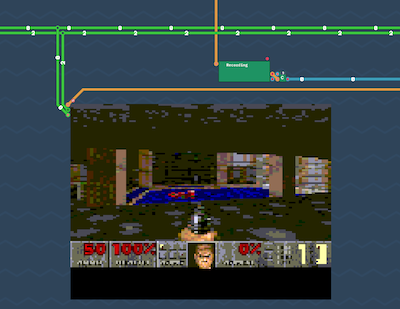
Doom is compiled without using the C standard library or any header files, relying solely on compiler built-ins and manually defined interfaces. The project demonstrates an extreme minimalist approach to building a fully functional Doom executable while eliminating traditional C dependencies.
Doom runs on a custom 32-bit Bicep CPU built inside Turing Complete. The project extends the game's LEG architecture, adds a RISC-V to Bicep translator, and compiles EmDoom to run on the virtual processor, with real-time performance achievable through Verilog export.
Doom runs on TCMIPS, a custom MIPS32 CPU and LLVM-based toolchain built entirely inside the game Turing Complete. The project demonstrates a complete software stack—from custom CPU and compiler to runtime—capable of running real C/C++ applications, including Doom, on a virtual processor.
On an CPU in the Game - Turing Complete
By Jonas Böhm (Dr_J0nes)
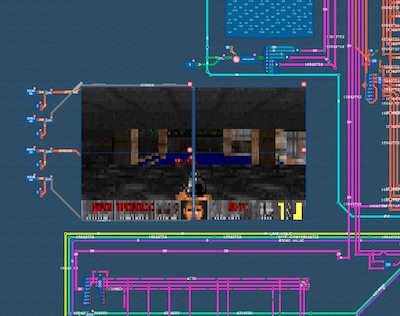
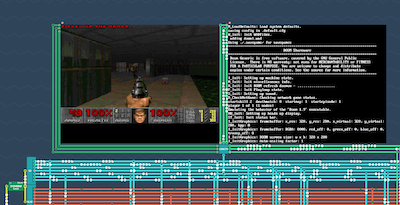
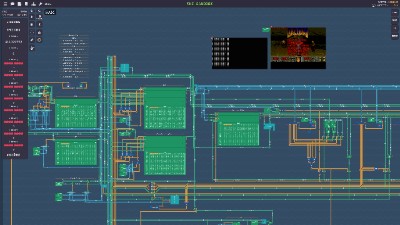
Turing complete is an education Game where you are led to build your own CPU step by step. After beating the Game I converted the LEG/Symphony CPU to 32-Bit and made it RISC-V compatible. I also added the M-Extension so it's officially an RV32IM CPU. I wrote a bootloader in assembly which reads one .ELF file from the "SSD" and loads it in the RAM. This meant I can compile and run C-Code on it. The next step was to make it run Doom. I used Doom Generic and added the necessary file where you can program your logic for keyboard inputs, what to do with the Screen Buffer and how timings and sleeps get handled. I also had to provide some standard C-Library functions for my architecture and I wrote an library for IO Stuff. In the end after a lot of trouble I got Doom compiling and running on the CPU. I used the save_breaker version btw.